16 November and 4 December 2024, Qudos Bank Arena, Sydney

I love Cold Chisel – Aussies all, or mostly, do – but this is not going to be the kind of write-up all those blokey music writers were writing during this 50th anniversary tour or the kind of breathless salivating social media posting everyone – men, women, children and their pets – were populating my feeds with through 2024.
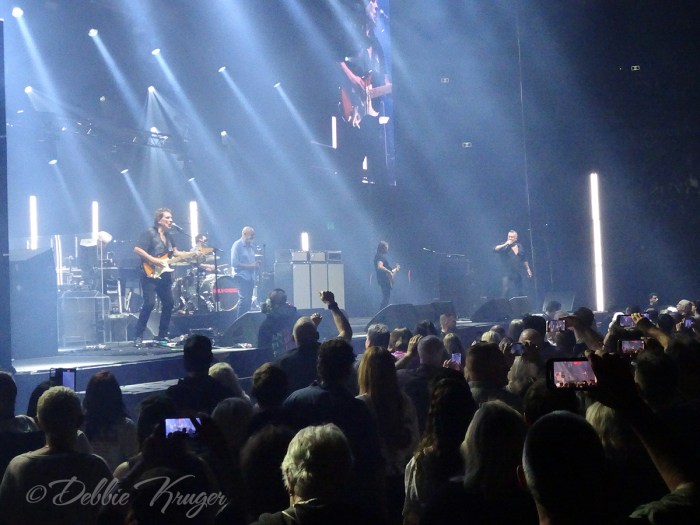
It is difficult for me to write anything particularly original about a band that is so beloved and lauded and so cocky that they refuse to even take a bow to acknowledge their adoring audience at the end of their show but whose music I genuinely do enjoy. Sharing the photos I took over the two nights I saw them might be the best I have to offer, along with a potted history of my experience of their music.
Because bound up in this is the weird cultural dissonance I feel that is really challenging to articulate.
Standing on the outside looking in. That was me at these shows. That’s been me for most of the past three years, back in Sydney.
Having displaced myself from my adopted natural habitat of California, it’s been difficult to reconnect with the Australian culture that I grew up with and cut my career teeth on. Heck, I wrote THE book on Australasian songwriters. I ran communications for the music copyright collection society APRA. I headed the PR in Australia for Apple’s launch of iTunes down under. I lived and died by what went to air on 2SM in the 1970s and Triple M in the 1980s. I spent my teens in the midst of massive crowds, sometimes high-six-figure crowds, for open-air free concerts largely performed by Australian artists, and traipsed all over Sydney to grubby scummy beer-stinking pubs and clubs to see Aussie bands. I still believe the 1970s Australian casts of Jesus Christ Superstar were the best in the world. Yep all of that.
But I became a California girl, a Santa Monica girl, and Cold Chisel doesn’t really fit into that cultural sensibility. (Whereas Midnight Oil, Nick Cave, even Kylie Minogue, are somehow able to slot into the American music milieu, even in passing. Now there is a thesis.)
I do proudly recall that in 1998, during a 12-month LA stint, I had Cold Chisel’s comeback album, The Last Wave of Summer, shipped to me and I drove up and down the freeways blasting it, loving it. It had nothing to do with the life I was living in LA at the time, but it was a great album to drive to.
Of course we take our music memories and inspirations with us through life wherever we are. I always get off on hearing one of my favourite Chisel songs, “Saturday Night”, and linking it to all those Saturday nights I’d stay in just to watch the Nine Network’s Hey Hey It’s Saturday program, for which the Cold Chisel song had become the opening theme. At the first of these two shows at Qudos Bank Arena, a soulless cavernous venue if ever there was one, there was a woman sitting near me wearing a t-shirt that said: “Well if you don’t like it what are you standing there for 20 minutes?”
Never was the acronym IYKYK more apt.

I had been standing on the outside looking in, kind of, for much of Cold Chisel’s first and most impactful era. Coming from the sumptuous pop and harmony rock I’d immersed myself in (read this on Sherbet and this on Little River Band), I was a late and reluctant adopter until “Saturday Night” finally won me over in 1984, after they had already played The Last Stand tour and broken up. It had seemed too rough and bogan for me, a “hell-raising, sweaty rampage” was how I described it in my book, Songwriters Speak. I did already have Breakfast At Sweethearts on vinyl from 1979 because everyone wanted that album cover and the songs weren’t too bad either. (I love “Showtime” a lot.) But I hadn’t truly heard it, the “it” that set Cold Chisel apart from all others. I hadn’t yet been studying the songwriting. The profound songwriting. Particularly the lyrically rich, minor chord-infused melodic bluesy rock songs penned by Don Walker.
After they broke up and their song was on Saturday night variety television, then I heard it. Really heard it and became a belated fan, with the Twentieth Century album, their breakup album, my favourite. I reckon anyone who hears the opening track, “Build This Love”, and doesn’t then fall in love with the whole album is missing a whole unique wall of sound of music that is stupendous.
I was so annoyed at myself for missing them during their peak, not seeing them when I should have, I even subjected myself to Jimmy Barnes shows at Selina’s and the Sydney Entertainment Centre in those first post-Chisel years, but that was not what I was after. So I listened and listened and kept listening to their records, from Cold Chisel to Breakfast At Sweethearts to East and Circus Animals, Twentieth Century and then, 15 years on, The Last Wave of Summer. Jimmy Barnes’s ripping-your-guts-out screeching voice only works for me when he is singing a Don Walker song – or a song by one of the other band members; they were all good writers, but Don Walker was the master of the profound. I met Don when the hit that was never a radio hit because it was banned, his song with no chorus, “Khe Sanh”, was included in the Ten Best Australian Songs for APRA’s 75th anniversary celebrations in 2001, and then I interviewed him for Songwriters Speak, one of my four favourite interviews in the book in fact, and I interviewed him again for other projects, and we stayed connected.
There would be no Cold Chisel without any of its members, and had drummer Steve Prestwich not died it would be one of the few bands in history with its classic lineup still together – that is, when they reunite every now and then – but there would absolutely be no Cold Chisel without Don Walker.
I had actually seen Chisel back in 1978, before they became colossal, both times opening for Sherbet (and, the second time, for Peter Frampton as well), which is equally as appropriate as AC/DC opening for Sherbet a few years earlier. Sherbet was pure pop but their audiences were huge, wild and receptive. Don Walker had plenty of respect for Sherbet’s pop songwriting, told me he thought “Child’s Play” was a really good song, and submitted to a thoughtful interview when I started working on a book about Sherbet a few years ago. (Still a work in progress, in case you are wondering.)
Cold Chisel and Sherbet were so interestingly connected that the intense sadness when both bands lost key members on the same sad weekend in January 2011 was gut-wrenching, and even while grieving the death of Prestwich, two Chisel members, Ian Moss and Phil Small, turned up a few weeks later to play at the tribute concert for Sherbet’s Harvey James.
In 2003 I saw them on their Ringside tour. I collected the later albums but I missed the subsequent tours. But when this Big 5-0 tour went on sale and I was sitting in Sydney grappling with my cultural disconnection, I was feeling some FOMO and potential SAMO (sadness), so I used Qantas frequent flyer points to buy a ticket for the November 16 show, and then I gratefully accepted the invitation to attend the December 4 show with a kind friend who had house seats. We sat in the row behind the members of Midnight Oil.
So I will say this here, that for all the claims by all the blokey music writers and friends and fans who raved all over the press and social media about Cold Chisel being the best Australian band that ever lived and the Big 5-0 shows being the best shows ever staged by an Australian band, I think Midnight Oil put on better shows in their later career than these Chisel shows. There was an Oils show I saw in LA in 2017 at the Greek Theatre that I really need to write about, even now, or at least post the photos from, that lives keenly in my memory.
Truthfully, it’s good to know both bands, their music and their members. A privilege in fact. But at these Chisel shows, at the end of their huge sell-out tour, I was looking for the grand, breathtaking, wall of sound-esque assault I experienced on record in 1984. Their musicianship is pure brilliance, without doubt, and Ian Moss is a great showman, fabulous to watch, fabulous to photograph. They rely on their songs and their legacy to bring in the crowds and they do. And yet… and yet. I didn’t feel it. It was fine, backing singers and all, but it was not extraordinary. Well, for the fans, it was extraordinary that it was happening at all, and I suppose that was the point and why the tour was so mammoth, and why I wanted to be there.
At these shows, I got off more on the relentlessly rampant songs like “Painted Doll” and “Merry-Go-Round” than the iconic “Cheap Wine” and “Flame Trees” or even “Khe Sanh”. For most Australian music fans seeing Cold Chisel is like a religious experience, and so perhaps it would be churlish of me to complain that it is tiring to only hear Jimmy Barnes speak while the other members play but don’t say anything, that Don hiding at the back behind his keyboards (which he has always done) is frustrating and that a photo-worthy line-up and bow at the very end would be really appreciated. FFS.
I was at the after-show schmooze backstage on the last night – seemed like everyone I had known in the music biz in Sydney was there as well, all the old cronies, quite lovely to see them – and I told Ian Moss, you know, it wouldn’t kill you guys to take a bow. He said something about how he would have liked to but the other guys didn’t want to. I think that is what I heard him say. He put a lot into those shows, and he seemed exhausted. Don was in very bright spirits and genuinely happy to see me, which made me feel tender and extra grateful that I was there, and on the way home I played some Cold Chisel, probably Twentieth Century, and nodded to myself and thought, yeah, I am truly glad I saw these shows and took a lot of photos but these were not the greatest shows ever staged by an Australian band, or any band. And every other band I have ever seen, in memory, takes a bow at the end and thanks their audience. This is not the 1981 Countdown Awards; you could look directly at your audience and give them a wave instead of getting up and walking off stage without a backward glance, ya know.
Maybe it’s not cultural dissonance at all; maybe I just wanted to be more moved than I was. That’s why after the first show, I wanted to go back for the second show a few weeks later; I felt there had to be more. I wanted to be transported, carried away with that rampant energy and lose my breath. And I guess in truth I didn’t want it to be such a bogan crowd, which makes me a cultural snob and a displaced multi-citizen. You can take the girl out of Australia but you can’t really take the Australian out of the girl, even if she is in a perpetual Hotel California existence that she cannot check out of let alone leave, making being back in Australia all the more jarring. But wanting the music to transcend nationality, transcend time and place, that’s what I seek.
Still, I did take some okay photos. So here they are. Click to enlarge.


 DEBBIE DOES MUSIC